
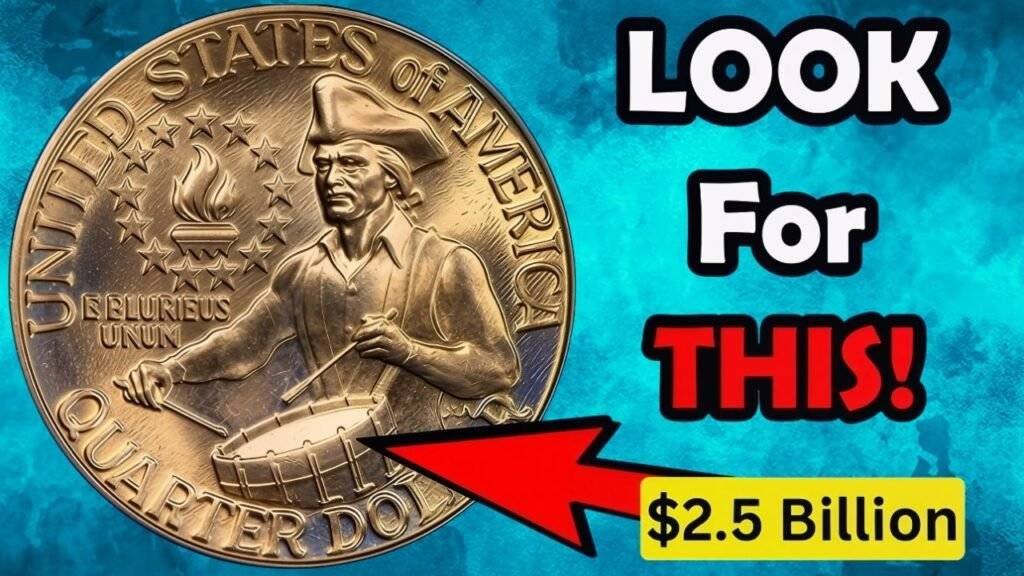

If someone told you an ordinary quarter sitting in your pocket could be worth millions—or in some extreme cases, be rumored as high as $2.5 billion—you’d probably laugh. Most people would. But the rising fascination around the Rare 1976 Quarter has captured the world of coin collectors like never before. Thanks to viral stories, shocking auction results, and fresh discoveries, millions of Americans have started digging through their old coin jars hoping to spot one of these treasures.
It might sound unbelievable, but certain versions of the Rare 1976 Quarter truly are worth life-changing amounts. And what’s even more surprising? These coins often appear in everyday circulation. Whether in an old drawer, a roadside vending machine, or spare change from a grocery store, the potential of finding a valuable Rare 1976 Quarter is real enough that collectors are on high alert.
In this comprehensive guide, we’ll break down exactly what makes the Rare 1976 Quarter special, why certain versions sell for insane prices, and how to identify the varieties worth thousands—or even more.
Why the 1976 Bicentennial Quarter Is So Iconic
To celebrate America’s 200th anniversary in 1976, the U.S. Mint released special Bicentennial-themed coins, including quarters, half dollars, and dollars. The quarter received one of the most distinctive redesigns in U.S. history: instead of the usual eagle, the reverse featured a colonial drummer, making it instantly recognizable.
Millions of these coins were produced, which means the average Bicentennial quarter holds only sentimental value. But within this enormous production run exist a small group of coins that are now classified as a Rare 1976 Quarter, commanding jaw-dropping prices in today’s collector market.
Where Did the $2.5 Billion Rumor Come From?
The internet loves an exciting headline, and nothing is more thrilling than the idea of a pocket coin being worth billions. While no proof exists that a Rare 1976 Quarter has sold for such an amount, the rumors originate from stories about Mint experiment coins—prototypes, patterns, and pre-production strikes created in tiny numbers.
These prototype coins were never meant to enter circulation, but if even one slipped out, its value could skyrocket due to its extreme rarity.
This doesn’t mean every Rare 1976 Quarter is instantly worth billions, but it does mean that unique experimental strikes can be unimaginably valuable.
Types of Rare 1976 Quarters Worth Big Money
To help you understand what to look for, here’s a clear look at the categories of the Rare 1976 Quarter that collectors want:
1. 1976-S Silver Proof Quarter
- Struck in 40% silver
- Highly polished surfaces
- Sell for hundreds or thousands in top grades
- Still one of the most commonly collected Rare 1976 Quarter types
2. 1976-S Silver Uncirculated Quarter
- Non-proof version
- Lower numbers exist
- High-quality specimens command strong values
3. Double-Die Error Quarters
These errors feature doubled lettering or design elements. Look closely at:
- “LIBERTY”
- “IN GOD WE TRUST”
- The drummer’s details
- The date
A double-die Rare 1976 Quarter can fetch thousands at auction.
4. Off-Center Strikes
If the coin image is misaligned, it becomes highly collectible.
- A slight misalignment = minor value
- A dramatic 30%+ shift = major value
5. Wrong Planchet Errors
These are some of the most valuable Rare 1976 Quarter types ever found.
They include quarters mistakenly struck on:
- Silver planchets
- Nickel planchets
- Foreign coin planchets
- Experimental metal blanks
These rare errors often appear at major auctions because they are incredibly scarce.
Also Read – IRS Announces $1,390 Direct Deposit Relief Payment For November 2025
How to Identify a Rare 1976 Quarter in Your Pocket
Finding a Rare 1976 Quarter doesn’t require expert equipment. Start with a simple visual inspection.
Here’s what you should check:
1. Check the Mint Mark
- S = San Francisco (silver and proof)
- D = Denver
- No Mint Mark = Philadelphia
The “S” mint mark is the most important when identifying a Rare 1976 Quarter.
2. Look at the Coin’s Edge
- Silver quarters have a solid silver-colored edge
- Regular quarters show copper in the middle
If your 1976 quarter looks silver all the way through, it might be a silver strike or even a Rare 1976 Quarter error coin.
3. Check the Weight
- Standard quarter: 5.67 grams
- Silver quarter: 5.75 grams
- Wrong-planchet coins: unusual weights
Unusual weight = potentially valuable Rare 1976 Quarter.
4. Look for Doubling
Use a magnifying glass or the zoom camera on your phone.
5. Inspect Alignment
Off-center designs are easy to spot.
Even a subtle misalignment can mean your Rare 1976 Quarter is worth far more than pocket change.
Value Guide for 1976 Quarters
Here’s a collector-friendly overview showing the possible value range:
| Type of 1976 Quarter | Estimated Value |
|---|---|
| Circulated Bicentennial Quarter | $0.25 – $1 |
| Uncirculated Quarter | $5 – $25 |
| 1976-S Silver Uncirculated | $15 – $200 |
| 1976-S Silver Proof | $50 – $3,000+ |
| Double-Die Error | $100 – $7,500+ |
| Off-Center Strike | $50 – $10,000 |
| Wrong Planchet Error | $5,000 – $250,000+ |
| Prototype / Experimental Strike | Up to $2.5 Billion (if ever confirmed) |
The last category is what drives the legend of the Rare 1976 Quarter being worth billions.
Why Some 1976 Quarters Are Worth a Fortune
The value of any Rare 1976 Quarter comes down to five factors:
1. Scarcity
Some types exist in extremely limited numbers.
2. Minting History
Experimental and test strikes hold legendary status.
3. Collector Demand
The Bicentennial design has strong emotional appeal.
4. Condition
Coins with minimal wear can increase in value 10x to 50x.
5. Mystery
Coins with undocumented origins or unusual metal compositions create huge collector excitement.
Put these elements together, and it becomes clear why the Rare 1976 Quarter market is exploding.
Should You Get Your Coin Appraised? Absolutely.
If your 1976 quarter appears silver, looks thicker, weighs differently, or shows odd markings, it may be worth having evaluated. Many people have unknowingly spent a Rare 1976 Quarter worth thousands simply due to lack of awareness.
Start with:
- Clear high-resolution photos
- Close-up shots of the mint mark
- Checking weight using a simple kitchen scale
- Comparing it with trusted coin guides
If it looks unusual, an appraisal could confirm whether you own a Rare 1976 Quarter worth an incredible amount.
Why the Rare 1976 Quarter Continues to Fascinate Collectors
The Bicentennial design holds emotional value. It marks a historic milestone in U.S. history and represents a moment of unity and pride. For many, it is nostalgic. For collectors, however, a truly Rare 1976 Quarter represents something much more:
- The possibility of owning a one-of-a-kind treasure
- A chance to hold a piece of Mint history
- The excitement of the hunt
It’s not just about money—it’s about the thrill of discovery.
Final Thoughts: Check Your Change—You Could Be Sitting on a Fortune
The Rare 1976 Quarter shows us that even the smallest, most ordinary objects can hold extraordinary value. While most 1976 quarters are worth face value, the rarest varieties could change someone’s life.
Every time you get change back at a store or open an old jar of coins, you’re potentially holding a hidden treasure. A Rare 1976 Quarter might be sitting in your pocket right now—waiting to be discovered.
So look closely. You never know when one coin might turn into thousands, millions, or—according to some rumors—billions. 🪙✨
FAQs About the Rare 1976 Quarter
1. Are most 1976 quarters valuable?
No, most quarters are only worth face value unless they fall under the Rare 1976 Quarter categories.
2. How do I know if mine is silver?
Check the edge—silver coins lack the copper strip.
3. Which mint mark should I look for?
The “S” mint mark is most valuable for the Rare 1976 Quarter varieties.
4. Can a normal Bicentennial quarter be worth millions?
Only if it has extremely rare errors or experimental striking.
5. Do collectors really pay billions?
Only for one-of-a-kind prototypes—an extremely rare scenario.
Some Important Link
| Download News APP | Click Here |
| WhatsApp Group | Click Here |
| Home Page | Click Here |